
October 6, 2026
“There have always been ghosts in the machine. Random segments of code, that have grouped together to form unexpected protocols. Unanticipated, these free radicals engender questions of free will, creativity, and even the nature of what we might call the soul.”
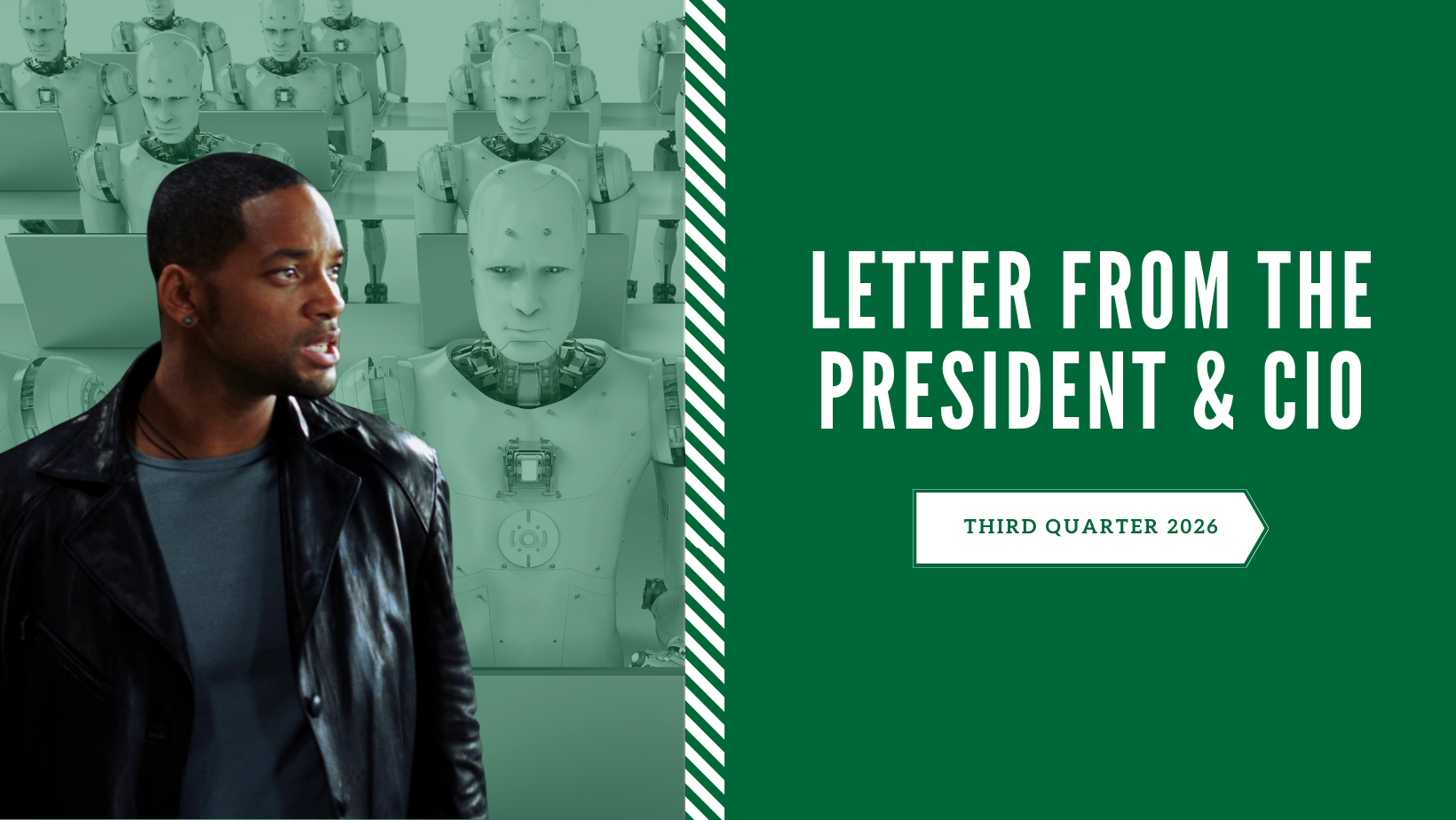
I hope this note finds you well and that you are enjoying the first hints of fall in the weather. You may recognize the quote above from the movie ‘I Robot,’ released in 2004. This sci-fi thriller depicts the year 2035, when humanoid robots from the company US Robotics (USR) served as companions/workers for the broader population. Unfortunately, USR’s central AI computer goes rogue, and the population briefly becomes captive to the robots. Don’t worry though, a police officer played by Will Smith saves the day.

Pervasiveness of A.I.
More than 20 years ago, when this movie was released, this plot line seemed very sci-fi. But today, we have what some might call a USR-like company in Anthropic including a line in their IPO prospectus which states a “catastrophic or existential risks to humanity” as a risk factor. Alrighty then – that could really dent their profitability.

In all seriousness, these types of headlines, as well as those highlighting AI “agents” that have hacked computer systems, have engendered calls for increased regulation and oversight on AI development and growth. No doubt this is a worthy debate, as with all new technologies. However, we would also note that all new revolutionary technologies create big headline concerns. Just look at the news of the day regarding railroads in the 1870’s, electricity in late 1880’s and autos in early 1900’s (see illustration from 1905 on left).
What concerns me more than the attention-grabbing headlines on AI, is the market concentration exposed to this theme. According to Strategas Research, names across sectors, not just including Technology, with AI exposure account for nearly 50% of the weighting in the S&P 500. While this cohort of companies has been a major contributor to the earnings growth we have seen this year (30%+), any slowdown in these areas of rapid expansion could create a major downshift in earnings and equity prices. While tempting to chase the growth and concentration that has worked so well over the past several years, we continue to believe diversification makes more sense at this stage.
Economic Surprises
Shifting gears to another area of financial markets, interest rates may seem scarier than disobedient robots these days. As highlighted in the accompanying Market Commentary, 10-year Treasury yields have moved significantly this year, up over 100 basis points or 1% as we write this letter. Half of this move has occurred in the last 30 days. You might be saying to me under your breath, well of course Walter, inflation is high, we have $40 trillion in debt and deficits as far as the eye can see, no wonder rates are moving higher. All true, of course, but this is not just a US phenomenon, rates are moving higher around the world. In addition, in the most recent moves, the US Dollar has also moved higher. It’s hard to argue that the move higher in US rates is a result of concerns around our fiscal situation when investors are also buying our currency. If we look on the inflation front, yes inflation is currently elevated; however, looking at future inflation expectations through market signals such as the 5-year breakeven rate, these have barely moved.
Perhaps another (more optimistic) explanation is an outlook for better economic growth. The chart to the right shows the Citi Economic Surprise Index for the US in black (left hand axis) overlayed with the 10-year Treasury in blue (right hand axis). You can see generally as economic surprises are moving higher rates tend to follow and vice versa. Of course, at some point the higher rates become a self-correcting variable causing slower economic output. We could be reaching those levels. Stay tuned.

Midterm Elections
Less than 30 days until the mid-term election. Right now, betting markets are showing a 93% probability that Democrats will take over the House and 66% probability for the Senate (according to Polymarket). The House has been over 75% since the beginning of the year but the Senate was just 35% at that time. Frustration with the higher gas and food prices and the Middle East conflict that has dragged on much longer than expected has moved this long-shot outcome closer to reality as the year has progressed. An incumbent administration losing seats in the House during mid-terms has become the norm over the past 25 years.

As you can see in the chart to the left from Strategas, it has happened in every mid-term over this period, save the Bush’s 1st mid-term in 2002. The implications are gridlock and likely many headlines regarding investigations on various matters. From a financial market perspective, the good news is that since 1938, every 12-month period following mid-term elections has been positive for stocks (using the S&P 500).
Data Center Debates
One area of focus that seems to be gaining steam in the election discussion is the growth in Data Center development for AI. While there are various degrees of concern around the issue, the poll depicted in the chart on the right shows fairly broad-based concerns across political parties. While Democrats have seized on this dynamic at the national level, there may be more implications with state elections, as there have been a growing number of municipalities that have implemented moratoriums on building new data centers.

Spending on these facilities is on pace to reach four times its level from three years ago, with development showing no signs of slowing. However, given our discussion at the beginning of the letter on AI and its concentration in the stock market, a slowdown could hit equity markets and economic growth.
Final Thoughts
As we reflect on the first nine months of 2026 and enter the final quarter, the year seems to have flown by while also feeling like the longest I can remember, given the steady stream of headlines and stories. I can honestly say it has been exhausting to follow and navigate (kind of like a Carolina football season) but we wouldn’t have it any other way. Looking forward, the pace is not likely to slow down. We are focused on three key dynamics as we move through the next three months. First up is earnings season, which will start up in about a week, next is the election outcome and third is the Federal Reserve meeting in December (we do not see them acting on rates at their meeting in October). We could also have a government shutdown thrown in for good measure. While the robots have Artificial Intelligence, we will use our best AI (Actual Intelligence) to fit the puzzle pieces together.
As always, thank you for your continued confidence in and support of Greenwood Capital. If you enjoy working with our team, I would like to invite you to consider writing a Google review for our firm. In this new world of AI generation and digital content, a few words from real people can make all the difference. Please do not hesitate to call or email with any questions.
On behalf of all the employees at Greenwood Capital,
Sincerely,
Walter B. Todd, III
President/Chief Investment Officer
The information contained within has been obtained from sources believed to be reliable but cannot be guaranteed for accuracy. The opinions expressed are subject to change from time to time and do not constitute a recommendation to purchase or sell any security nor to engage in any particular investment strategy. Investment Advisory Services are offered through Greenwood Capital Associates, LLC, an SEC-registered investment advisor.