
July 6, 2026
“I guess I should warn you, if I turn out to be particularly clear, you’ve probably misunderstood what I’ve said.”
I hope this letter finds you well and that you enjoyed the 250th July 4th celebrations over the past weekend. It’s hard not to open with a quote from our Founding Fathers (jump to the end for that), but with the passing of former Fed Chairman Alan Greenspan recently, I had to go with one of my all-time favorites from him above. The Maestro, as he was nicknamed, actually said this when testifying before Congress.

Greenspan served five terms as Chairman under four administrations, famously taking over for Paul Volcker in 1987 under Reagan and stepping down in 2006 under Bush. He presided over the crash of October 1987 but also the boom of the 1990s. Of course, his passing at the age of 100 coincidentally comes at a time of transition at the Federal Reserve under the new direction of Kevin Warsh whose first meeting was in June (more on this below). The graphic to the right has been hilariously accurate in terms of the direction of rates and the height of the Fed Chair over the past 40+ years. In case you are wondering, Warsh’s estimated height is the same as Powell at six feet. RIP Chairman Greenspan and I’ll try to be a little clearer than he was when speaking to Congress.
Fed Chair Kevin Warsh’s opening meeting was an eventful one. He described the two-day gathering and discussion of the FOMC as a “good family fight” that resulted in a unanimous decision to do nothing. While the decision of ‘no rate change’ was widely telegraphed, the dot-plot (an estimate of what each Fed member currently feels will be the future path of rate moves) struck a decidedly more hawkish tone in predicting a hike at some point in 2026. This conflicts meaningfully with the cut that was predicted in the prior version. Chair Warsh’s dot was notably absent. This, along with the lack of guidance metrics and a published statement that was half the size of previous versions served as signals of a different version of the FOMC going forward.

We were also informed of the development of five task forces to examine various aspects of existing Fed operations and decision making. While the inner workings of the Federal Reserve are hardly page-turning material, I want to use the topics of these task forces as a framework for a broader discussion this quarter. In no particular order, the topics to be examined by Warsh are 1) Fed Communications 2) Balance Sheet Considerations 3) Data and Economic Analysis 4) Productivity and Jobs and 5) Inflation Framework.
Inflation Framework
Taking these out of the order listed above, I will begin with the Inflation Framework discussion as this seems the most relevant in the near-term to potential policy decisions. For context, it was Chairman Bernanke’s Fed that formally adopted the 2% inflation target in January 2012. This was done in an effort to increase transparency and accountability in monetary policy. The average inflation rate, as measured by the Personal Consumption Expenditures (PCE), is 2.3% since this target was implemented. Not bad, right? However, as averages often are, this one is misleading as well because in the 172 year-over-year readings released monthly since January 2012, the 2% target has been achieved on exactly 6 occasions (or roughly 3% of the time). The Fed spent the period 2012 through 2020 trying to get inflation up to target with an average of 1.4% and post-Covid, has spent the last four years working to move inflation back down to target while averaging 3.9%. The correct way to measure inflation gets into the Data and Economic Analysis task force discussion, but for now inflation remains elevated and the statement from Warsh’s first FOMC said “The Committee will deliver price stability.”
Not surprisingly, given this stance, expectations for a rate hike increased to over 100% by December 2026. Recall, when 2026 began, markets expected two rate cuts this year. The significant development over the past several weeks, however, is the Memorandum of Understanding (MOU) between the US and Iran.

The negotiations between the two sides remain ongoing (that may be a stretch given the ceasefire without the “cease”), but energy markets have already repriced with oil down 34% and national gasoline prices down 17% from their recent peaks. It is worth noting that these levels are still up 17% and 20% on a year-over-year basis, respectively (see Bloomberg chart at left). Bottom line, inflation is set to move lower in the months ahead but will likely remain above the elusive target of 2.0%.
Productivity and Jobs
Moving on to Productivity and Jobs, this task force was designed to focus on trends in these areas, including the impact of AI and technological change. This has, of course, been a topic of much discussion over the past several years and has become more in focus recently with a number of companies announcing job cuts presumably related to AI. While there is much speculation related to productivity enhancements to come from these new tools, the verdict is still out. In fact, the CEO of Meta, Mark Zuckerberg, made the statement several days ago that AI agent development over the prior four months “hasn’t really accelerated in the way that we expected.”
As an economic variable, productivity is notoriously volatile as it simply measures economic output (GDP) per employee. For example, when the number of employed collapsed during Covid, productivity spiked to 21% in 2Q20 only to fall to -3% by 4Q20. No doubt the Warsh Fed will look for new and better ways to capture this data, but in the interim, the debate around a “productivity boom” from AI will remain.
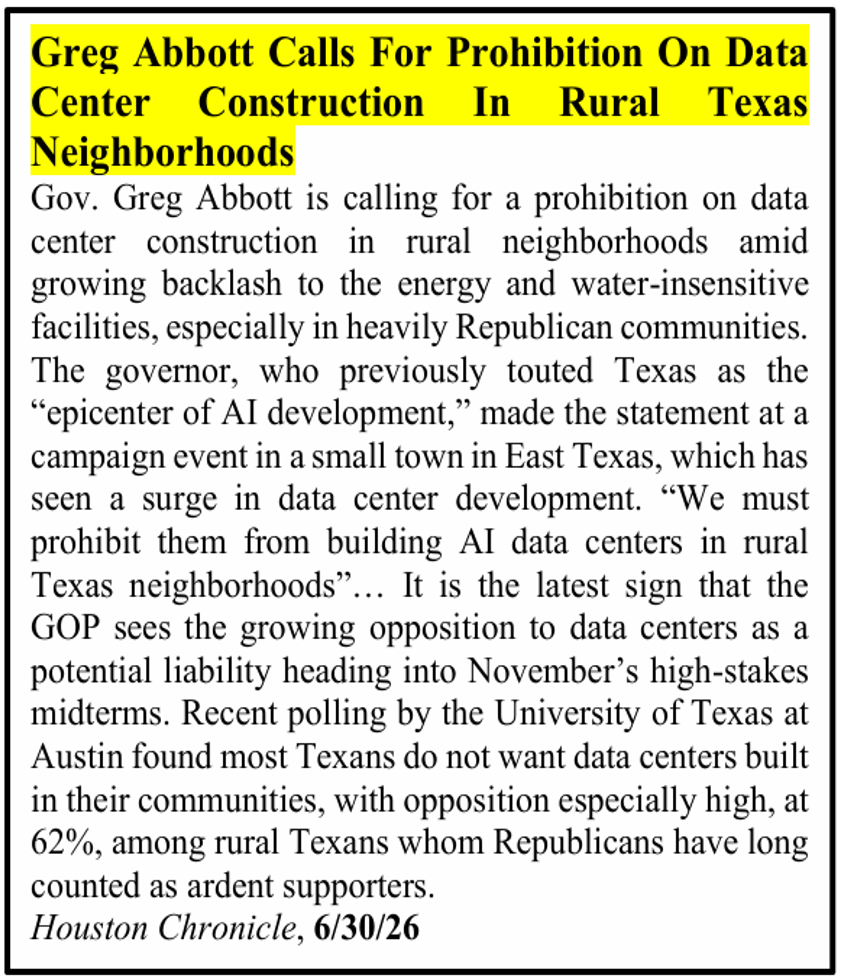
The outcome of this conversation has important implications for inflation because without productivity increases, the massive investment component related to the buildout of AI is inflationary on its own. To wrap up this specific task force discussion, I thought the headline captured at right was interesting. Presumably, you need to continue the buildout to get the benefits of AI in the future and attitudes are quickly changing about the impact of that buildout. More to come on this dynamic, I’m sure.
Data and Economic Analysis
I will not spend too much time on the topic of Data and Economic Analysis. We have discussed before the challenges with data gathering in recent years, with response rates for surveys in many cases falling well below 50%. The Trump administration recently revamped the Bureau of Labor Statistics (BLS) with new leadership to improve the timeliness and accuracy of statistics from this government agency. It may seem crazy, but markets are reacting in real time as these numbers come out only to have them significantly revised months later. This task force is likely to look for more real-time alternative sources of data on a variety of economic variables. One example of these would be looking at real-time credit card data from Visa and Mastercard on spending compared to the monthly retail sales reported by government generally three weeks after month-end. Many market participants (including ourselves) look at this alternative data already, but we would welcome the Fed making policy decisions with more timely and precise data.
The Balance Sheet
The Balance Sheet discussion is probably the biggest elephant in the room among the five task forces created. Warsh, who was on the Fed from 2006 to 2011, has long been a critic of the use of the Fed Balance Sheet to implement monetary policy and this was one of the reasons he resigned from the Board in 2011. The Federal Reserve balance sheet (blue line pictured in Bloomberg chart, below right) was roughly $900 billion before Lehman Brothers collapsed in September 2008. It reached a peak of just under $9 trillion, post-Covid in early 2022, a 10x increase over 14 years. While no one is advocating for a return to pre-Lehman levels, Warsh made it clear during his confirmation hearing that we would like to shrink the balance sheet over time.
Why does this matter? The red line in the chart is the S&P 500 Index. Many would argue that the liquidity provided by the explosion in the Fed balance sheet was a significant contributor to the increase in asset prices. It is said that correlation does not equal causation and to be sure the move higher in the S&P 500 from 2022 to 2026 as the balance sheet is falling contradicts the conclusion of the relationship between the variables.

However, I would submit the ever-expanding Fed balance sheet has created the conditions for asset prices (and government and corporate debt) to move higher, faster than they otherwise would have. In addition, the recent move higher in stocks over the past four years coincides with the roll-out of ChatGPT in 2022 and the AI theme that has driven markets ever since. This highlights the risk of a shifting attitude toward AI highlighted in the prior section.
Federal Reserve Communications
Ending this exhilarating discussion with the topic of Federal Reserve Communications, we have often made the statement internally that transparency does not equal clarity. Chair Warsh seems to buy into this concept and as referenced above, it started with the short and to the point statement issued in his first meeting followed by the fact that he did not submit a forecast for future rate decisions in the “dot plot.” He did participate in the post-meeting press conference and answered questions but indicated that this may not always be the case going forward.
What you may not realize is that all the transparency and communication we have grown accustomed to in recent years did not exist until relatively recently. The Federal Reserve was established in 1913 and for the first 81 years of its existence did not issue statements of their actions or meetings. In fact, “the market” did not find out until days later about changes to the Fed Funds Rate that dot every headline today after a Fed meeting. It was not until 1994 that then Chair Greenspan instituted the practice of issuing statements if actions were taken by the Fed. In 2000, they began issuing statements after each meeting, regardless of any actions taken.
While press conferences were occasionally held in the past and more frequently post the Global Financial Crisis, it was former Chair Powell in 2019 that implemented press conferences after every meeting. We believe the goal of this “less is more approach” to communications from the Warsh Fed is for market participants to be less concerned about how the Fed will react to incoming data and instead react based on the fundamental data itself. We agree with this concept but acknowledge it is easier said than done and may create more volatility in response to monetary policy changes in the future.
Final Thoughts
As we close this letter, let us acknowledge and celebrate the 56 brave delegates who ratified and signed the Declaration of Independence in 1776 (the final paragraph of which is quoted below). From the British perspective, these men committed high treason and would have been hanged, drawn, and quartered if caught. The risk they took with their lives unleashed what would become the most powerful democracy in history. While headlines today highlight the differences between us, on this 250th anniversary of the birth of our country, let us resolve to remember the commonalities that make us all Americans.
“We, therefore, the Representatives of the United States of America, in General Congress, Assembled, appealing to the Supreme Judge of the world for the rectitude of our intentions, do, in the Name, and by Authority of the good People of these Colonies, solemnly publish and declare, That these United Colonies are, and of Right ought to be Free and Independent States; that they are Absolved from all Allegiance to the British Crown, and that all political connection between them and the State of Great Britain, is and ought to be totally dissolved; and that as Free and Independent States, they have full Power to levy War, conclude Peace, contract Alliances, establish Commerce, and to do all other Acts and Things which Independent States may of right do. And for the support of this Declaration, with a firm reliance on the protection of divine Providence, we mutually pledge to each other our Lives, our Fortunes and our sacred Honor.”
As always, thank you for your continued confidence in and support of Greenwood Capital. If you enjoy working with our team, I would like to invite you to consider writing a Google review for our firm. In this new world of AI generation and digital content, a few words from real people can make all the difference. Please do not hesitate to call or email with any questions.
On behalf of all the employees at Greenwood Capital,
Sincerely,
Walter B. Todd, III
President/Chief Investment Officer
The information contained within has been obtained from sources believed to be reliable but cannot be guaranteed for accuracy. The opinions expressed are subject to change from time to time and do not constitute a recommendation to purchase or sell any security nor to engage in any particular investment strategy. Investment Advisory Services are offered through Greenwood Capital Associates, LLC, an SEC-registered investment advisor.